
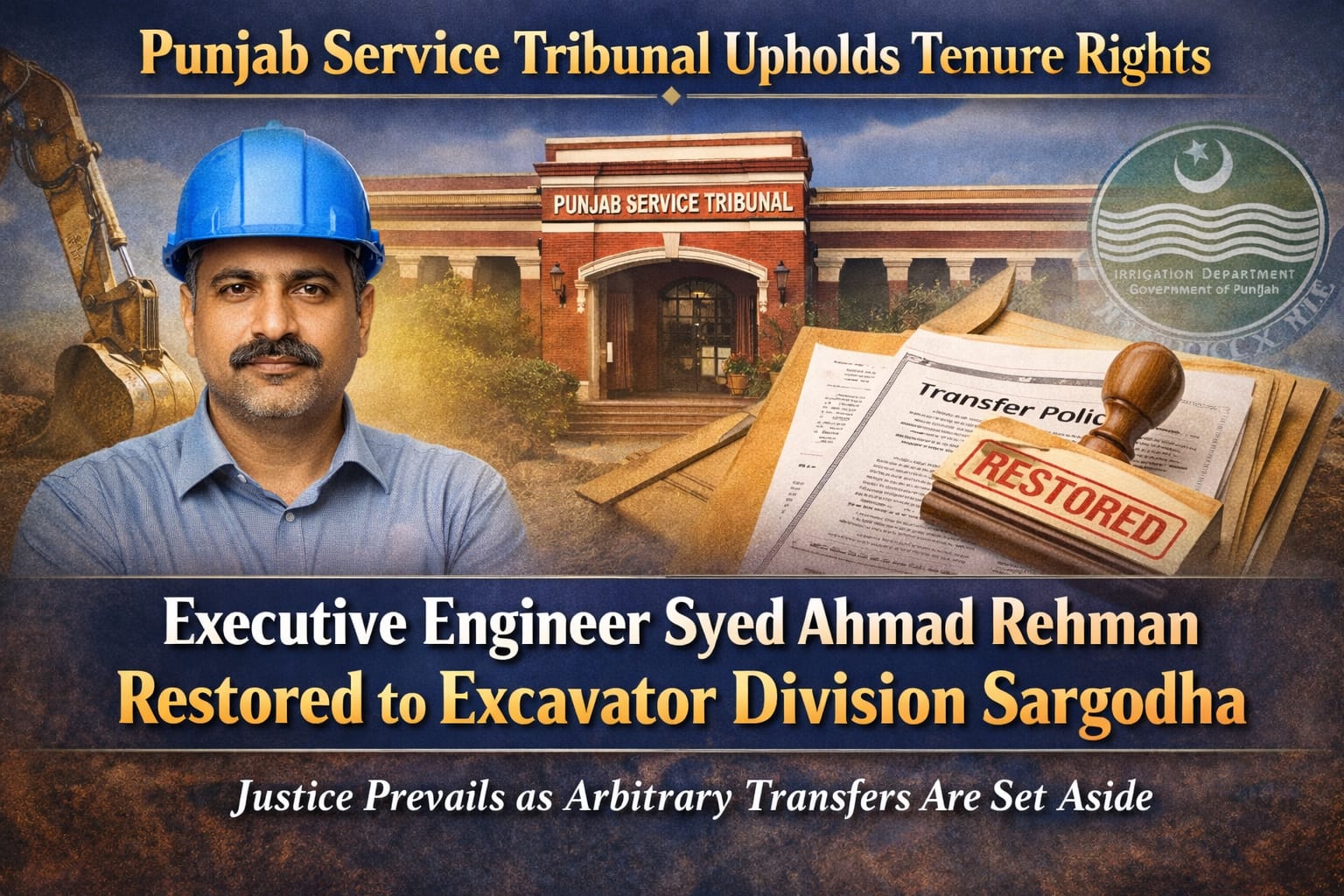
Justice Prevails as Arbitrary Transfers Are Set Aside
In a significant decision, the Punjab Service Tribunal has allowed the service appeal of Syed Ahmad Rehman, Executive Engineer (BS-18), setting aside the premature transfer and suspension orders issued by the Irrigation Department, Government of Punjab. The judgment emphasizes the rule of law, fairness, and proper adherence to service policies, reinforcing that administrative actions must be supported by lawful justification.
📌 Background of the Case
The appellant, Syed Ahmad Rehman, was originally posted as Executive Engineer at the Excavator Division, Sargodha on 28.09.2022. Before completing the ordinary tenure prescribed under the Transfer Policy, 2013, he was transferred to the Sheikhupura Canal Division on 27.06.2024. Subsequently, the appellant was suspended on 18.07.2024 and directed to report to the E-1 Section of the Department.
Challenging these actions, the appellant filed a departmental representation, which remained undecided. He then approached the Punjab Service Tribunal via Service Appeal No.1861/2024. Earlier, the Lahore High Court had suspended the impugned suspension order on 02.08.2024, and the Tribunal later suspended the transfer order on 30.08.2024, allowing the appellant to resume his duties at the Excavator Division, Sargodha, on 03.09.2024.
⚖️ Legal Arguments
Counsel for the appellant, Mr. Allah Nawaz Khosa, Advocate, argued that:
- Under Clause 5 of the Transfer Policy, 2013, the appellant is entitled to complete a three-year tenure at the Excavator Division, Sargodha, from 30.08.2024 to 29.08.2027.
- The impugned transfer lacked compelling reasons, as mandated by the law, and was arbitrary, potentially motivated by political influence.
- Reliance was placed on precedents, including 2018 SCMR 1411 and PLD 2013 SC 195, which emphasize that ordinary tenures must be respected, and any deviation requires valid justification subject to judicial review.
The District Attorney argued that civil servants can be transferred anywhere in the interest of service, citing departmental discretion.
📖 Tribunal Findings
Upon review, the Tribunal noted:
- No compelling reasons were recorded to justify the appellant’s premature transfer.
- The transfer violated the Transfer Policy, 2013 and disrupted administrative efficiency.
- As the transfer was unlawful, the subsequent suspension (18.07.2024) and inquiry (22.08.2024) orders were also unsustainable.
- Administrative actions must comply with legal norms and documented reasons, as held in the Supreme Court precedents cited.
✅ Final Decision
The Tribunal allowed the appeal and set aside:
- Transfer order dated 27.06.2024
- Suspension order dated 18.07.2024
- Inquiry order dated 22.08.2024
- Appellate order dated 16.10.2024
The respondents were directed to ensure that the appellant completes his full three-year tenure as Executive Engineer, Excavator Division, Sargodha, till 29.08.2027, in strict compliance with the Transfer Policy, 2013, and other applicable laws.
👨⚖️ Appreciation of Legal Advocacy
This favorable outcome highlights the meticulous and strategic advocacy of Mr. Allah Nawaz Khosa, Advocate. His in-depth understanding of service law, reliance on binding legal precedents, and precise articulation of the appellant’s rights were instrumental in ensuring justice.
The judgment underscores the importance of dedicated legal counsel in protecting civil servants against arbitrary administrative actions and ensuring that government policies are implemented lawfully and fairly.
📌 Conclusion
The Tribunal’s decision serves as a precedent for safeguarding tenure rights under the Transfer Policy, 2013, reinforcing that administrative discretion must be exercised responsibly, transparently, and with documented justification.
It is a strong reminder to government departments that compliance with procedural rules and respect for ordinary tenure are essential for fair governance and administrative stability.