
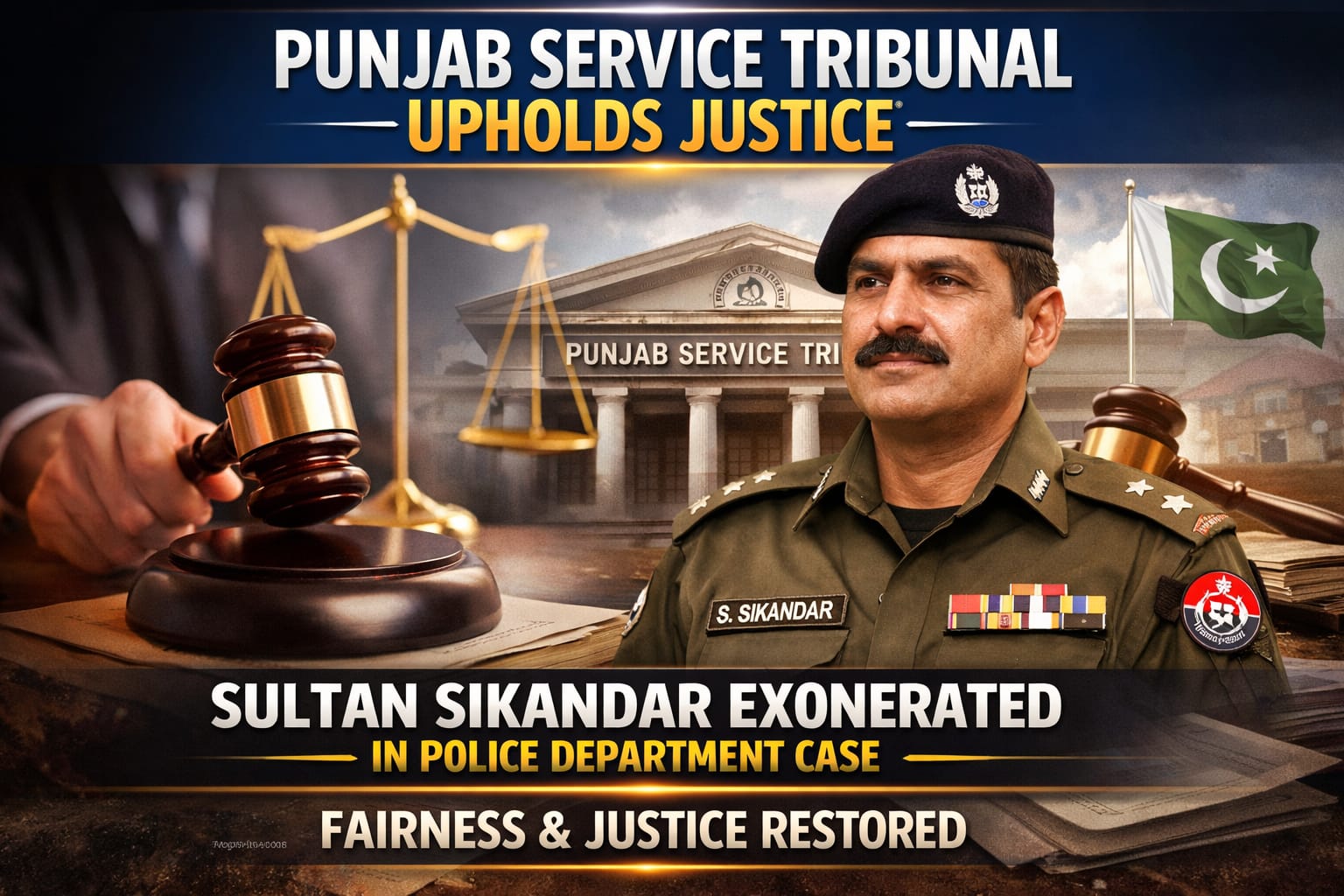
Punjab Service Tribunal Upholds Justice: Sultan Sikandar Exonerated in Police Department Case
Meticulous Legal Advocacy Ensures Fairness in Disciplinary Proceedings
In a landmark decision, the Punjab Service Tribunal has allowed the service appeal of Sultan Sikandar, previously posted as Incharge PP Malhal Mughlan, setting aside the penalties imposed by the Punjab Police and reinstating justice in disciplinary proceedings. The judgment underscores that punishment in service matters must be based on concrete evidence and proper procedural compliance.
📌 Background of the Case
The appellant, Sultan Sikandar, faced disciplinary proceedings under the Punjab Police (E&D) Rules, 1975, via charge sheet dated 04.12.2024 issued by the DPO Chakwal. Allegations included:
- Taking a foreign national, Babar Shahzad, from Islamabad to Chakwal without informing senior officers
- Keeping the individual in unauthorized detention
- Registering a case and allegedly seeking bribe for personal gain
- Violating chain of command and tarnishing the police image
Following an inquiry conducted by DSP Investigation, Chakwal, the appellant was found guilty, and the penalty of forfeiture of approved service for one year was imposed on 09.01.2025. His departmental appeal before the RPO, Rawalpindi was rejected on 30.04.2025, prompting the appellant to approach the Service Tribunal.
⚖️ Legal Arguments
Advocate Allah Nawaz Khosa, representing the appellant, argued that:
- The inquiry was procedurally defective and not conducted in accordance with law.
- No prosecution evidence was recorded to substantiate the charges.
- The inquiry report was merely a narration of allegations and the appellant’s defense, without any cross-examination or corroboration.
- The competent and appellate authorities failed to independently scrutinize the evidence, instead mechanically relying on the inquiry officer’s recommendations.
Citing Supreme Court precedents, including 2004 SCMR 294 and Chief Secretary, Government of Punjab v. Muhammad Ali Saqib (2020 SCMR 1245), Mr. Khosa emphasized that:
“Orders of the competent authority as well as departmental appeal must be based on independent scrutiny of evidence. Punishments cannot rely solely on inquiry recommendations without proven allegations.”
The District Attorney argued in favor of the punishment, contending that the appellant failed to produce evidence of innocence.
📖 Tribunal Findings
After examining the record, the Tribunal observed:
- No credible evidence was recorded by the inquiry officer to substantiate the charges.
- The inquiry relied on assumptions and unverified allegations, ignoring the defense of the appellant.
- Punishment was imposed arbitrarily without satisfying the requirements of natural justice.
- Both the competent and appellate authorities failed to refer to any incriminating material against the appellant in their orders.
The Tribunal held that disciplinary action must always be supported by tangible evidence, and reliance on unverified recommendations is legally unsustainable.
✅ Final Decision
The Service Tribunal allowed the appeal, setting aside:
- Penalty order dated 09.01.2025
- Appellate order dated 30.04.2025
The decision vindicates Sultan Sikandar, highlighting that procedural fairness and evidence-based decision-making are paramount in disciplinary proceedings.
👨⚖️ Appreciation of Legal Advocacy
This judgment reflects the meticulous legal representation of Advocate Allah Nawaz Khosa, whose strategic approach and thorough understanding of service law were instrumental in securing justice. His ability to challenge procedural defects, highlight lack of evidence, and rely on binding legal precedents underscores the critical role of competent legal counsel in safeguarding the rights of public servants.
📌 Conclusion
The Tribunal’s decision serves as a precedent for fair and lawful disciplinary action in the Punjab Police. It reinforces that:
- Punishments must be evidence-based
- Inquiry reports cannot substitute for proper scrutiny by authorities
- Legal representation is crucial for protecting the rights of officials facing arbitrary administrative actions
