Bench: Justice Muhammad Ali Mazhar, Justice Syed Hasan Azhar Rizvi
Case: Tariq Khan & Aman Ullah v. Additional Director General (North) FIA & Others (Civil Petitions Nos. 3463 & 3464 of 2021)
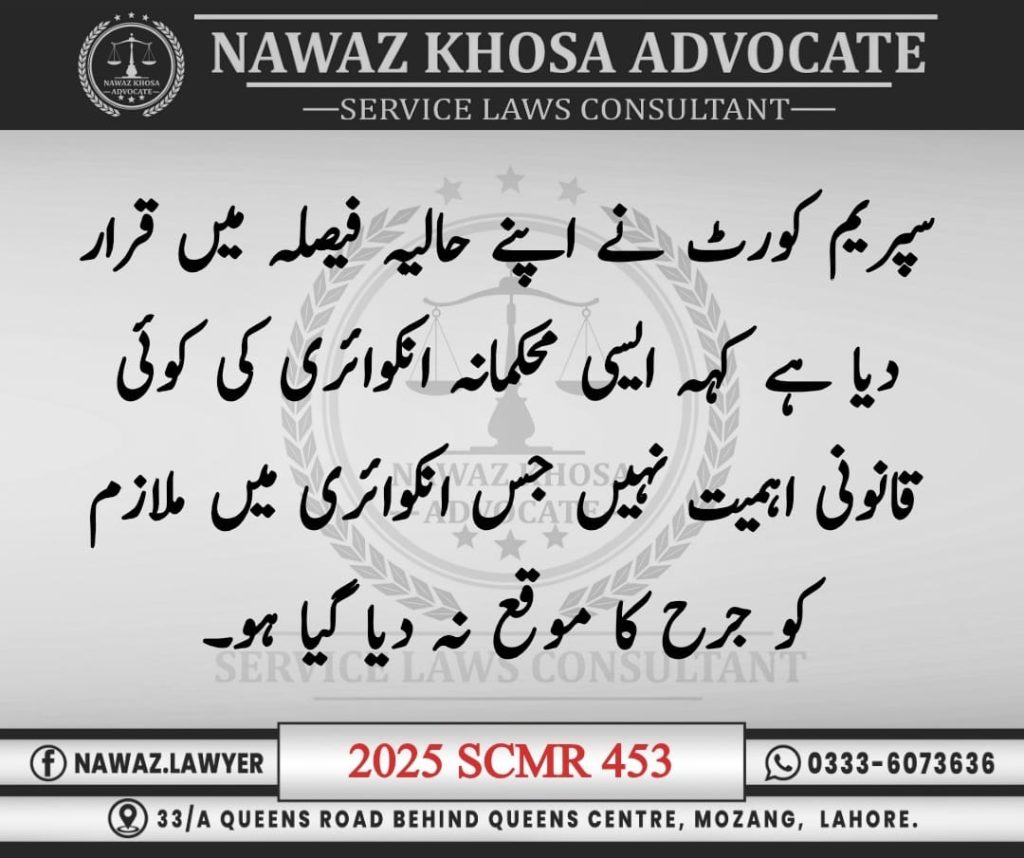
The Supreme Court of Pakistan set aside the compulsory retirement of two FIA officials, ruling that the denial of cross-examination during departmental proceedings rendered the inquiry unlawful. The Court emphasized that the right of cross-examination is a fundamental component of fair trial under Article 10A of the Constitution.
The petitioners, Tariq Khan (ASI) and Aman Ullah (Head Constable), were accused of clearing passengers with fake Schengen visas at Bacha Khan International Airport, Peshawar. They were awarded the major penalty of compulsory retirement in 2019. The Federal Service Tribunal upheld the punishment in 2021, prompting the petitioners to approach the Supreme Court.
Petitioners’ Arguments
- No opportunity of cross-examination was given during the inquiry.
- No evidence established their mens rea, mala fide, or corruption.
- Out of five officials charged, only the petitioners were compulsorily retired, while others were either given lighter penalties or exonerated.
- Past service records were spotless, making the punishment disproportionate.
Respondents’ Position
- The FIA maintained that the petitioners failed to detect fake visas and consult their supervisors, constituting gross negligence.
- The departmental action was taken in accordance with rules.
- The State, however, conceded that the petitioners could face a fresh inquiry if ordered.
Supreme Court’s Findings
Justice Muhammad Ali Mazhar observed:
- Violation of Fair Trial: Cross-examination is not a concession but a vested right, essential in civil, criminal, and departmental proceedings.
- Defective Inquiry: The inquiry report itself noted no link between the petitioners and alleged facilitators, yet punished them without proper defence.
- Discriminatory Punishment: Two junior officials faced compulsory retirement while senior officers were exonerated on the same evidence.
- Principle of De Novo Inquiry: Where serious procedural lapses occur, proceedings must start afresh from the beginning, ensuring due process.
Decision
- Appeals allowed; FST judgment set aside.
- Department directed to hold a de novo inquiry within three months.
- The compulsory retirement penalty will remain subject to the outcome of the fresh inquiry.
Key Legal Takeaways
- Cross-examination is indispensable in disciplinary proceedings.
- Unequal treatment of similarly placed employees violates principles of fairness.
- Courts can order de novo inquiries to cure defects in earlier proceedings.
- Article 10A of the Constitution guarantees fair trial and due process in all departmental actions.