Service Tribunal Grants Relief to Police Official: Dismissal Converted into Minor Penalty
Justice, Proportionality & Effective Legal Advocacy at Work
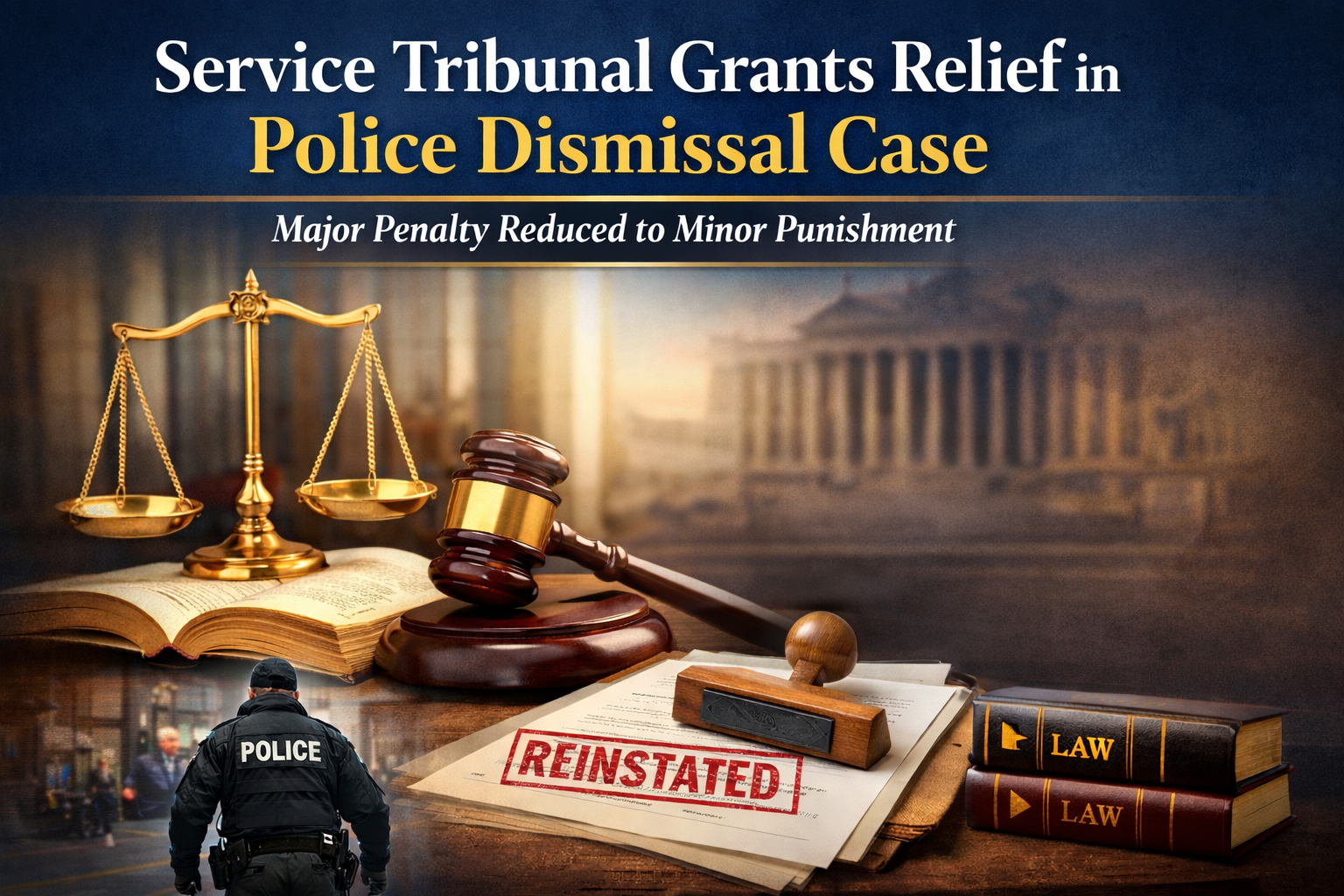
In an important service jurisprudence development, the Service Tribunal has partially allowed the appeal of Saddam Hussain versus Police Department, setting aside the harsh punishment of dismissal from service and converting it into a minor penalty. The decision reinforces the well-settled legal principle that punishment must be proportionate to the gravity of the charge and not arbitrary or excessive.
📌 Background of the Case
The appellant, Saddam Hussain, a police official, was proceeded against under the Punjab Police (Efficiency & Discipline) Rules, 1975 through charge sheets dated 15.09.2022 and 26.09.2022. He was accused of:
- Involvement in a criminal case
- Willful absence from duty for 22 days, 10 hours, and 48 minutes without leave
Based on these allegations, the competent authority awarded the major penalty of dismissal from service vide order dated 25.10.2022. Subsequent departmental appeal and revision were also rejected on 21.03.2024 and 07.06.2024, compelling the appellant to approach the Service Tribunal.
⚖️ Arguments by the Appellant
The case was ably argued by Mr. Allah Nawaz Khosa, Advocate, who forcefully contended that:
- The alleged absence was neither willful nor deliberate, but due to unavoidable circumstances
- The punishment of dismissal was grossly disproportionate to the alleged misconduct
- The impugned orders were based on conjectures and surmises, without proper appreciation of evidence
- The criminal case registered against the appellant had already resulted in acquittal
- Mandatory principles laid down by Hon’ble Superior Courts regarding proportionality and natural justice were completely ignored
Mr. Khosa further emphasized that even if the charge of absence was assumed, the same did not justify a major penalty like dismissal from service.
🏛️ Response from the Department
On the other hand, the learned Deputy District Attorney argued that all codal and legal formalities had been fulfilled and that the appellant had brought a bad name to the department, therefore not deserving any leniency.
📖 Findings of the Tribunal
After hearing both sides and examining the record, the Service Tribunal observed that:
- The period of absence (22 days) did not justify the extreme punishment of dismissal
- The competent authority failed to consider the gravity of charges in light of IGP’s Instructions dated 21.12.1995
- The punishment was harsh, disproportionate, and violative of principles of natural justice
The Tribunal relied upon authoritative precedents, including:
- 1988 PLC 639
- M. Sharif & others v. IGP Punjab (2021 SCMR 962)
These judgments clearly establish that punishment must be commensurate with the misconduct proved.
✅ Final Decision
The appeal was partially allowed, and the impugned orders were modified as under:
- The major penalty of “Dismissal from Service” was converted into
“Reduction in pay by two stages for two years” - The appellant was ordered to be reinstated into service
- The intervening period was directed to be treated as leave without pay
👨⚖️ Appreciation of Legal Effort
This relief would not have been possible without the meticulous advocacy, sound legal reasoning, and professional competence of Mr. Allah Nawaz Khosa, Advocate. His ability to effectively highlight violations of law, reliance on binding precedents, and focus on proportionality of punishment played a decisive role in securing justice for the appellant.
Such representation reflects the true spirit of service law practice, ensuring that disciplinary authorities remain within legal bounds and that public servants are not subjected to arbitrary penalties.
📌 Conclusion
This judgment serves as a strong reminder that disciplinary powers are not unfettered and must be exercised reasonably, lawfully, and proportionately. It also reinforces the crucial role of competent legal counsel in safeguarding fundamental rights within the framework of service law.