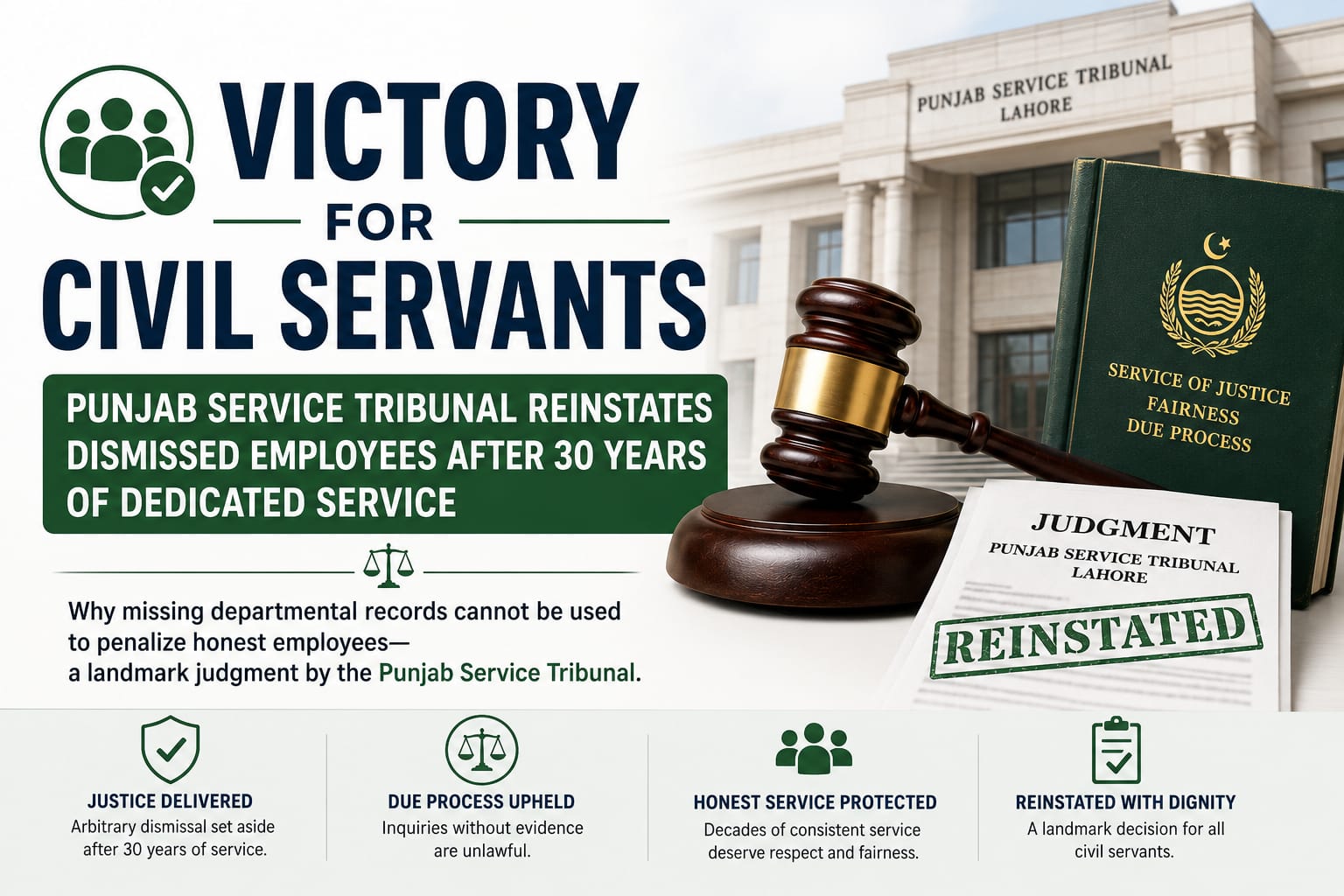
Title: Victory for Civil Servants: Punjab Service Tribunal Reinstates Dismissed Employees After 30 Years of Dedicated Service
Catchy Subtitle: Why missing departmental records cannot be used to penalize honest employees—a landmark judgment by the Punjab Service Tribunal.
A landmark judgment by the Punjab Service Tribunal (PST), Lahore, has delivered a major victory for civil servants facing arbitrary administrative actions. The Tribunal officially set aside the dismissal orders of two veteran Union Council Secretaries, reinstating them into service after a prolonged legal battle.
The consolidated judgment, delivered by Member-IV Shan-ul-Haq, marks a significant moment for the enforcement of due process, natural justice, and the protection of long-serving public employees.
The Background: Dismissal Based on “Missing Records”
The case involved Muhammad Ashraf and Muhammad Abid Sial, both appointed as Secretaries of Union Councils in late 1996. After nearly three0 years of continuous service, official postings, and regular salary withdrawals audited by the state, the Local Government and Community Development Department abruptly dismissed both individuals in April 2025.
The department alleged that the employees had managed “fake” initial appointments, citing that certain original recruitment files were currently missing or untraceable within the department’s offices.
The Turning Point: Theft by a Custodian Established
The defense successfully shifted the burden of proof back onto the department by bringing crucial facts to light:
- The Record Theft of 1999: The defense highlighted a critical, archived fact—in 1999, an official FIR was registered against a departmental sanitary worker, Riaz Masih, who was caught stealing and selling office records. He was later convicted and removed from service.
- The Tribunal’s Ruling: The Tribunal ruled that employees cannot be penalized for missing records when the department itself acknowledges that its files were stolen while under official custody.
Key Legal Takeaways from the Judgment
The Punjab Service Tribunal highlighted several vital principles of service jurisprudence that set a massive precedent:
- Inquiries Without Evidence are Unlawful: The department failed to call formal witnesses, produce original documents, or provide the appellants an opportunity to cross-examine anyone during the inquiry. The PST reiterated that administrative assumptions or inter-departmental notes cannot replace formal proof.
- Decades of Consistent Conduct Matter: The fact that the state accepted service, maintained their service books, allocated GP Fund accounts, issued official transfers, and paid salaries for three decades created overwhelming circumstantial evidence in favor of the employees.
- Suspension Cannot Rest on Mere Suspicion: Long-standing careers cannot be disrupted based on presumptions or missing documentation unless explicit, ironclad proof of fraud is established.
The Tribunal accepted the appeals, struck down the dismissal and departmental rejection orders, and ordered the immediate reinstatement of both officials.
Appreciation of Effort: Mr. Allah Nawaz Khosa, Advocate
The successful outcome of this complex case is directly credited to the exceptional legal strategy, meticulous paperwork, and relentless advocacy of Mr. Allah Nawaz Khosa, Advocate, counsel for the appellants.
Defending civil servants against heavy-handed state allegations of fraud requires a highly skilled approach. Mr. Khosa expertly dismantled the department’s case through several key legal actions:
- Assembling a Complete Paper Trail: Despite the department claiming lack of documentation, Mr. Khosa managed to present an extensive paper trail, including old seniority lists from 1998, 2001, and 2021, verified service book entries, and decades of pay bills to prove continuous, legal service.
- Leveraging Departmental History: His brilliant invocation of the 1999 office record theft directly neutralised the department’s primary argument regarding the “missing original appointment letters”.
- Enforcing Supreme Court Precedents: He successfully held the inquiry committee accountable to the strict letter of the law, forcing the Tribunal to recognize that a regular inquiry is legally invalid if it denies the accused the fundamental right to cross-examination.