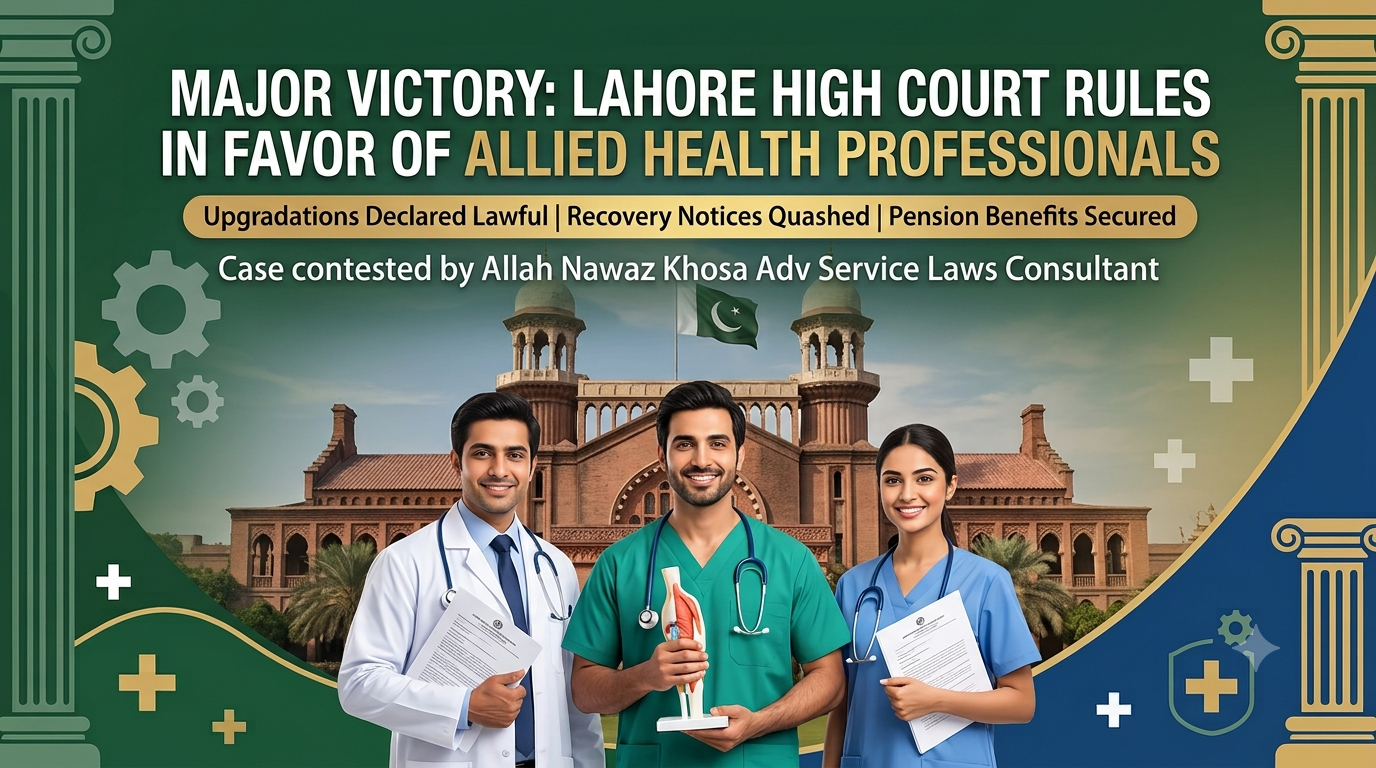
Major Victory: Lahore High Court Rules in Favor of Allied Health Professionals, and Declares Upgradations Lawful
Alhamdulillah! The promise made to the Allied Health Professionals has finally been fulfilled.
In a landmark judgment, the Lahore High Court has ruled in favor of government employees—specifically the paramedical and allied health staff of the Health Department—by setting aside the recovery notices issued by the Government of Punjab. The court declared all upgradations granted since 2011 as perfectly legal and directed that employees retiring from upgraded posts must receive pensions and retirement benefits corresponding to those very posts.
Case Details
- Case Number: Writ Petition No. 15682 of 2026
- Parties: Muhammad Iqbal Javaid & another v. Secretary Government of the Punjab & others
- Counsel for Petitioners: Allah Nawaz Khosa, Advocate High Court
Case Background: What Was the Issue?
On November 24, 2011, the Government of Punjab issued a notification restructuring the paramedical cadre under the 4-Tier Allied Health Services Structure. Under this policy, the petitioners’ posts were formally upgraded and redesignated in 2015.
The employees served in these upgraded positions for several years until their retirement on November 4, 2023. Following their retirement, the government refused to issue their pensions based on the upgraded scales and instead issued recovery notices for past payments. Aggrieved by this decision, the employees approached the Lahore High Court.
Key Legal Questions Before the Court
The Lahore High Court evaluated three primary legal questions in this case:
- Should an employee retiring from an upgraded post receive a pension calculated according to that specific post?
- Can the government withdraw an already granted upgradation without issuing a prior notice or providing a proper right of hearing?
- Does the High Court lose its constitutional jurisdiction in such matters due to Article 212 of the Constitution of Pakistan (which deals with Service Tribunals)?
Significant Legal Principles Settled by the High Court
Relying on multiple landmark judgments of the Supreme Court of Pakistan, the High Court established the following vital principles:
- Upgradation vs. Promotion: The court clarified that an upgradation is not a promotion; rather, it is the direct outcome of a specific government policy.
- Jurisdiction and Article 212: Since matters of structural upgradation do not fall strictly under the standard “Terms and Conditions of Service,” the High Court can rightfully exercise its constitutional jurisdiction. Therefore, the bar under Article 212 does not apply.
- Principles of Natural Justice: Once an employee has legally received the benefit of an upgradation, that benefit cannot be withdrawn arbitrarily without legal authority, a formal notice, and a meaningful opportunity to be heard.
- Doctrine of Locus Poenitentiae: If a government order creates certain vested legal rights in favor of an employee, those rights cannot be rescinded later without lawful justification.
- Status of Non-Speaking Orders: Vague, unreasoned (non-speaking), and illegal executive orders cannot be sustained in the eyes of the law.
Upholding Consistency: Reliance on Precedents
The court maintained judicial consistency by citing its own previous decisions, notably W.P. No. 11158 of 2022 and W.P. No. 80089 of 2022, where it was held that:
- Employees must be considered retired from their upgraded posts.
- Pension and all retirement benefits must be calculated and paid according to the upgraded scales.
- Recovery notices issued on the pretext of excess payments lack legal justification and cannot stand.
Finding the current petition identical to the past cases, the court allowed the writ petition to maintain consistency in judicial rulings.
Arguments by Counsel and Impact of the Verdict
Allah Nawaz Khosa, Advocate High Court, effectively argued the case on behalf of the petitioners. He presented strong precedents from the superior judiciary to prove that the government’s recovery drive was entirely unlawful.
Protecting Employee Rights: This judgment serves as a major victory and a powerful precedent for thousands of government employees in Punjab, particularly paramedical staff and allied health professionals. It reinforces the principle that the state cannot unilaterally strip employees of their legally acquired rights.