Lahore High Court Landmark Judgment: Rule 17-A Appointments Declared Protected as Past and Closed Transactions
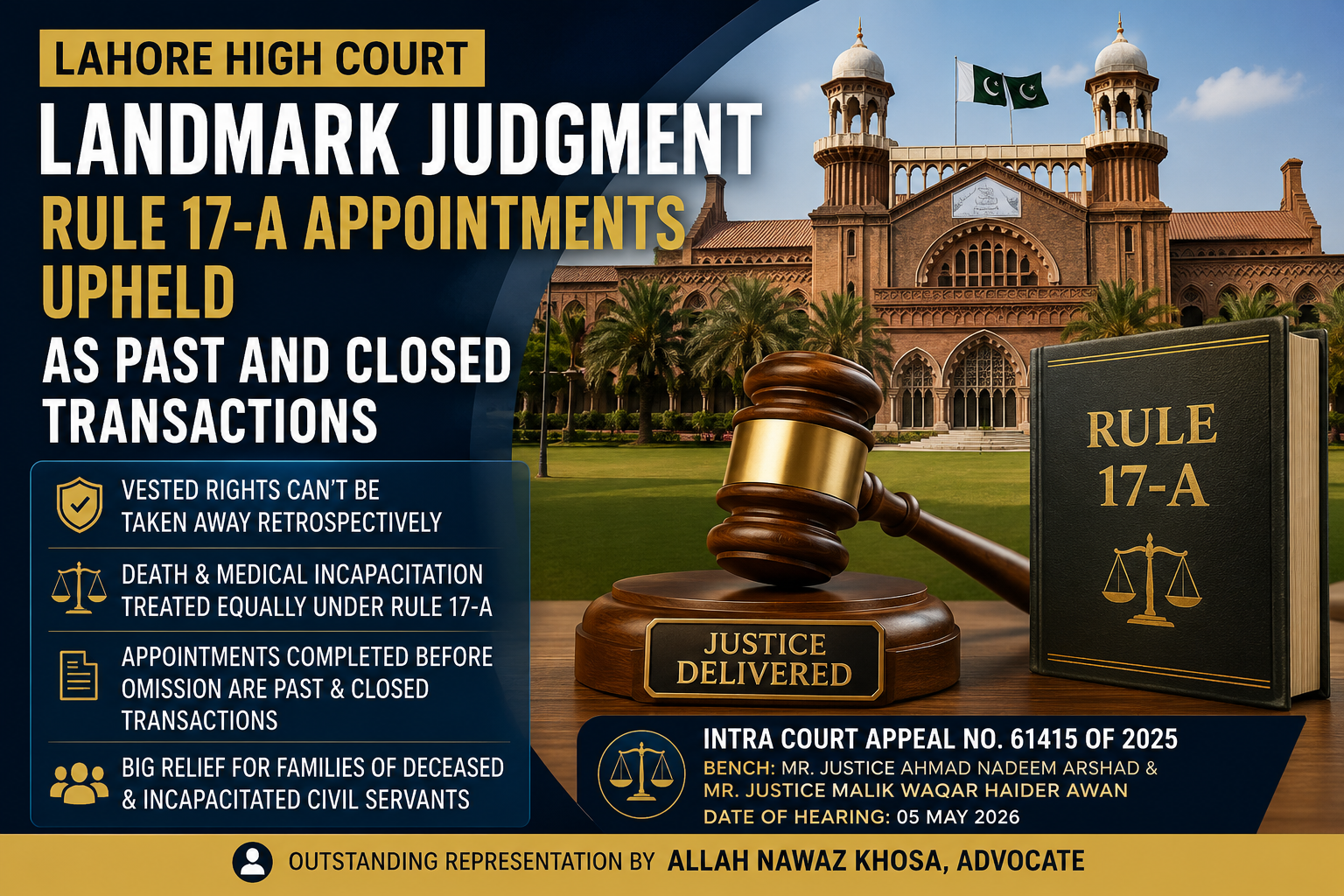
The Lahore High Court has delivered a significant judgment in Intra Court Appeal No. 61415 of 2025, dismissing the appeal filed by the Government of the Punjab and upholding the rights of employees appointed under Rule 17-A of the Punjab Civil Servants (Appointment and Conditions of Service) Rules, 1974.
The Division Bench, comprising Mr. Justice Ahmad Nadeem Arshad and Mr. Justice Malik Waqar Haider Awan, affirmed the earlier judgment of the learned Single Bench and held that appointments completed before the omission of Rule 17-A constituted past and closed transactions that could not be disturbed retrospectively.
This judgment is a landmark victory for civil servants and the families of deceased or medically incapacitated government employees who were appointed under Rule 17-A.
Background of the Case
The respondents were recommended for appointment under Rule 17-A of the Punjab Civil Servants (Appointment and Conditions of Service) Rules, 1974, which provided employment to eligible family members of deceased or medically incapacitated civil servants.
After successfully completing all statutory and departmental formalities, including medical examination and verification, the respondents were issued appointment letters in July 2024 and formally joined their respective posts.
However, following the omission of Rule 17-A, the Government of the Punjab withdrew their appointment letters through orders dated 18 October 2024, contending that the rule no longer existed.
Feeling aggrieved, the respondents challenged the withdrawal orders before the Lahore High Court, where the learned Single Judge allowed their petitions. The Government subsequently preferred an Intra Court Appeal, which has now also been dismissed.
Important Findings of the Lahore High Court
The Division Bench reaffirmed several well-established constitutional and administrative law principles.
1. Appointments Became Past and Closed Transactions
The Court held that once the respondents had:
- Completed all codal formalities;
- Been issued valid appointment letters;
- Joined government service; and
- Started performing official duties,
their appointments attained finality and became past and closed transactions, which could not be reopened because of a subsequent change in law.
2. Vested Rights Cannot Be Taken Away Retrospectively
The Court observed that rights which have already accrued under the law prevailing at the relevant time cannot subsequently be defeated merely because the governing rule has later been omitted or amended.
Once appointment is lawfully completed, the employee acquires vested rights deserving constitutional protection.
3. No Distinction Between Death and Medical Incapacitation
The Government attempted to argue that previous Supreme Court judgments protected appointments relating only to deceased employees and not medically incapacitated employees.
The Division Bench categorically rejected this contention, holding that Rule 17-A itself treated both deceased and medically incapacitated civil servants equally, and therefore no artificial distinction could legally be created.
4. Administrative Authorities Cannot Defeat Completed Appointments
The Court reiterated that once governmental authorities themselves complete every legal requirement and appoint an employee, they cannot later nullify those appointments merely because of a subsequent policy or legislative change.
Such retrospective action violates settled principles governing vested rights and legal certainty.
Significant Observation of the Court
“Once a right accrues under the law prevailing at the relevant time, it cannot be defeated by a subsequent declaration or change in law, particularly when the matter has attained the status of a past and closed transaction.”
This observation reinforces one of the most important principles of constitutional and service jurisprudence—that completed legal rights remain protected despite subsequent legislative or policy changes.
Outstanding Legal Representation by Allah Nawaz Khosa, Advocate
A noteworthy feature of this landmark success was the exceptional legal assistance rendered by Mr. Allah Nawaz Khosa, Advocate, who represented the respondents before the Lahore High Court.
Through comprehensive legal research, persuasive constitutional arguments, and reliance upon binding judicial precedents—including authoritative judgments concerning vested rights and past and closed transactions—Mr. Khosa successfully demonstrated that:
- completed appointments cannot be withdrawn retrospectively;
- vested rights deserve constitutional protection;
- Rule 17-A placed deceased and medically incapacitated employees on identical legal footing; and
- administrative authorities cannot invalidate appointments after all statutory requirements have been fulfilled.
His careful preparation, command over service jurisprudence, and effective advocacy played a significant role in safeguarding the employment and livelihoods of deserving families affected by the withdrawal orders.
The judgment represents another important contribution to the development of Pakistani service law and further strengthens the constitutional protection available to government employees against arbitrary administrative action.
Why This Judgment Is Important
This judgment establishes that:
- Completed Rule 17-A appointments cannot be cancelled retrospectively.
- Government authorities cannot reopen finalized appointments after employees have joined service.
- Vested rights remain protected despite subsequent legislative changes.
- The doctrine of past and closed transactions continues to safeguard completed governmental actions.
- Rule 17-A applies equally to cases of death and medical incapacitation.
The decision will serve as an important precedent in future service litigation involving retrospective cancellation of appointments and accrued employment rights.
Case Details
Court: Lahore High Court, Judicial Department
Case: Intra Court Appeal No. 61415 of 2025
Bench: Mr. Justice Ahmad Nadeem Arshad & Mr. Justice Malik Waqar Haider Awan
Date of Hearing: 05 May 2026
Counsel for Respondents: Mr. Allah Nawaz Khosa, Advocate