
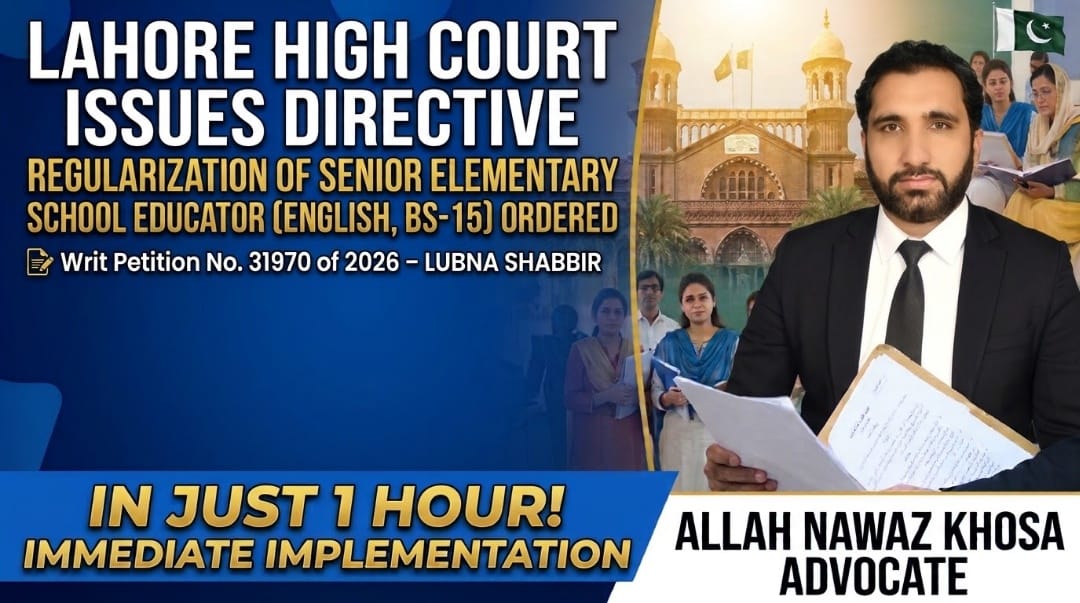
Historic Lahore High Court Judgment: Teacher Regularization and the Principle of Equality
The Lahore High Court has delivered an important judgment concerning the regularization of teachers appointed as Senior Elementary School Educators (English), BS-15, under the Education Department, Government of Punjab.
In Writ Petition No. 31970 of 2026, titled Lubna Shabbir v. Government of Punjab & Others, the Court addressed a significant legal question: Can an employee be denied regularization merely because the department failed to arrange the prescribed induction training, particularly when other employees appointed through the same recruitment process have already been regularized despite facing the same situation?
The Honourable Court answered this question in favour of the petitioner and directed the competent authorities to regularize her services.
Background of the Case
The petitioner, Lubna Shabbir, was appointed as a Senior Elementary School Educator (English), BS-15, on 22 September 2021.
However, the Education Department refused to regularize her services on the ground that she had not completed the prescribed Induction Training.
Aggrieved by the departmental decision, the petitioner approached the Lahore High Court through Writ Petition No. 31970 of 2026, challenging the refusal to regularize her services.
The principal contention was that the petitioner had been subjected to discriminatory treatment because other educators appointed through the same recruitment process had already been regularized, although they had also not completed the required induction training.
Key Legal Findings of the Lahore High Court
- Discrimination Prohibited Under Article 25 of the Constitution
The Court took notice of the fact that other educators appointed through the same recruitment process, including those mentioned at serial numbers 2, 3, 4, 5 and 7, had already been regularized through Notification dated 24 March 2025.
Importantly, those educators had also not completed the prescribed induction training.
The Court examined this issue in the light of Article 25 of the Constitution of Pakistan, which guarantees equality before law and equal protection of law.
The department cannot adopt different standards for employees belonging to the same recruitment process without lawful justification.
- Departmental Failure to Arrange Training Cannot Be Attributed to the Employee
Another significant aspect of the judgment concerned the responsibility for arranging induction training.
Under Clause 9 of the appointment agreement, the arrangement and scheduling of induction training were the responsibility of the Quaid-e-Azam Academy for Educational Development (QAED) or the concerned department.
The Court recognized that an employee cannot be penalized for an administrative failure attributable to the department itself.
Where the department fails to arrange the required training within the relevant period, such failure cannot automatically become a ground for denying an employee a legitimate service benefit.
- Effect of Repeal of the Punjab Regularization of Service Act, 2018
The Court also considered the timing of the petitioner’s representation.
The petitioner had submitted her representation on 18 November 2024, whereas the Punjab Regularization of Service Act, 2018, was repealed on 31 October 2025.
The legal significance of the matter was examined in the context of rights and claims arising before the repeal of the legislation.
The repeal of a statute does not, by itself, automatically extinguish rights that had already accrued under the previous law, subject to the applicable statutory provisions and legal principles.
Final Decision of the Lahore High Court
After examining the facts, departmental record and legal submissions, the Lahore High Court accepted the writ petition.
The Court:
- Set aside the impugned departmental order refusing regularization.
- Recognized the discriminatory treatment faced by the petitioner.
- Directed the competent authorities to regularize the services of Lubna Shabbir as Senior Elementary School Educator (English), BS-15, on the same basis as her similarly placed colleagues.
The judgment reinforces the constitutional principle that similarly situated employees must be treated equally and that administrative shortcomings cannot be used arbitrarily to deprive employees of their lawful rights.
Allah Nawaz Khosa Advocate’s Legal Representation
The petitioner was represented by Allah Nawaz Khosa Advocate, Service and Constitutional Lawyer, before the Lahore High Court.
During the proceedings, the petitioner’s case was presented on the basis of important constitutional and service-law principles, particularly:
- Article 25 of the Constitution of Pakistan.
- Equal treatment of similarly situated employees.
- The department’s responsibility to arrange mandatory induction training.
- Protection of employees against administrative negligence.
- The legal consequences of repeal of the Punjab Regularization of Service Act, 2018.
The legal arguments highlighted that an employee should not suffer adverse consequences because of a failure on the part of the competent department to fulfil its administrative obligations.
Legal Significance of the Judgment
This judgment carries considerable significance for educators and other government employees facing similar regularization issues.
It highlights the following important principles:
- Employees appointed through the same recruitment process should not be subjected to discriminatory treatment.
- Administrative failure to arrange mandatory training should not automatically become a ground for denying regularization.
- Article 25 of the Constitution protects employees against unjustified unequal treatment.
- Claims and rights arising before the repeal of legislation must be examined in accordance with the applicable law.
- Government departments are required to act fairly, consistently and in accordance with constitutional principles.
Conclusion
The Lahore High Court’s decision in Lubna Shabbir v. Government of Punjab & Others, W.P. No. 31970 of 2026, is an important development in service jurisprudence concerning teachers’ regularization.
The judgment emphasizes that the government cannot apply different standards to similarly situated employees or penalize an employee for administrative failures beyond their control.
The case also demonstrates the importance of constitutional remedies in protecting the service rights of government employees.
Allah Nawaz Khosa Advocate continues to represent government employees in service, constitutional and employment-related matters before the competent courts.
Legal Representation:
Allah Nawaz Khosa Advocate
Service & Constitutional Lawyer
33/A Queens Road, Behind Queens Centre, Mozang, Lahore.
WhatsApp for Appointment: 03336073636
For legal consultation regarding service matters, regularization, promotion, transfer, termination and other constitutional issues, appointments can be arranged through WhatsApp.

